728x90
728x90
https://arxiv.org/abs/2305.14788
Adapting Language Models to Compress Contexts
Transformer-based language models (LMs) are powerful and widely-applicable tools, but their usefulness is constrained by a finite context window and the expensive computational cost of processing long text documents. We propose to adapt pre-trained LMs int
arxiv.org
이 논문도 llm의 제한된 context window, long context 리소스가 많이 드는 것을 말한다. 그리고 같은 문서나 페세지를 여러 번 쓸 때 전체 텍스트를 다시 attention 하는 것도 비효율로 본다.
그래서 긴 텍스트를 짧은 softprompt 형태의 summary vector로 압축하는 방식으로 해결하려고 함.
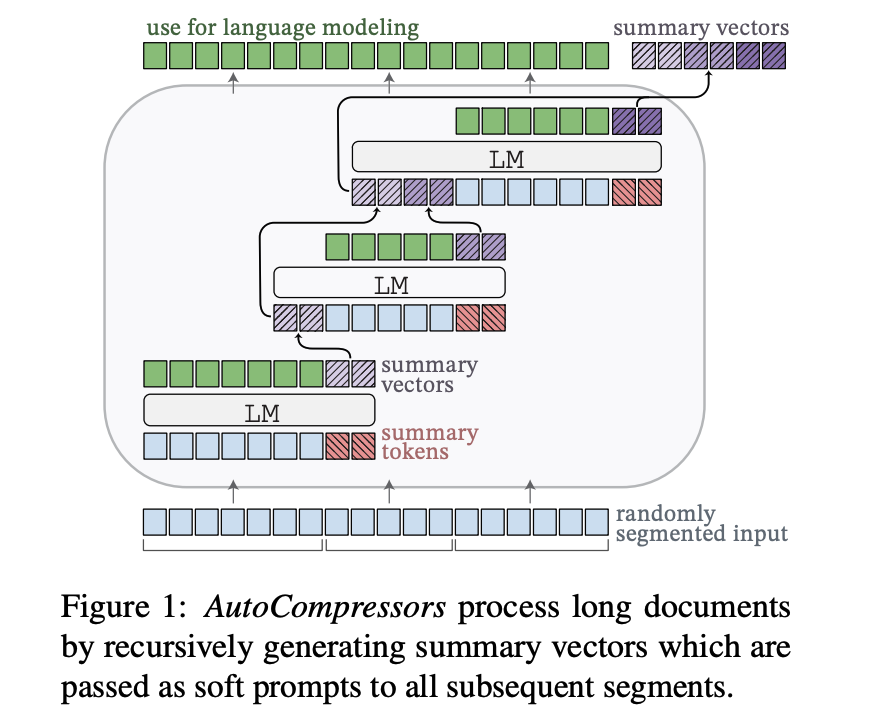
긴 문서를 여러 segment로 나누고, 각 segment를 처리한 뒤 summary token 위치의 hidden state를 summary vector 로 활용해 이 것을 soft prompt 처럼 사용함
이 것을 다 이어 붙여서 활용하네요
| Recurrent Memory Transformer | AutoCompressor | |
| 메모리 전달 | 직전 segment summary만 전달 | 모든 이전 segment의 summary를 누적 |
| 정보 경로 | (S_{i-1} → S_i) 중심 | (S_1, ..., S_{i-1} →S_i) 직접 접근 |
| 긴 문맥 유지 | 장거리 정보 손실 가능 | summary accumulation으로 장거리 정보 유지 강화 |
| 학습 segment | 고정 segment 위주 | randomized segmenting 사용 |

잘 보이진 않는데 Auto compressor가 ppl도 낮은 장점을 가지고 있네요



| 핵심 문제 | Transformer LM은 context window가 제한되어 있고, 긴 문서를 full attention으로 처리하면 계산/메모리 비용이 큼. 따라서 긴 문맥을 더 짧고 재사용 가능한 형태로 압축할 필요가 있음. |
| 핵심 아이디어 | 사전학습 LM을 AutoCompressor로 fine-tuning하여 긴 문맥을 summary vectors라는 짧은 continuous soft prompt로 압축함. 이 summary vectors는 이후 segment나 downstream task에서 문맥 대체재처럼 사용됨. |
| 방법론 | 긴 문서를 여러 segment로 나눈 뒤, 각 segment 뒤에 <Sum> token을 붙임. 모델은 <Sum> 위치의 hidden state를 summary vector로 만들고, 다음 segment 입력 앞에 이 vector들을 soft prompt처럼 붙여 다음 토큰을 예측함. |
| 기존 RMT와 차이 | 기존 RMT는 주로 직전 segment의 memory만 넘기는 구조인 반면, AutoCompressor는 summary accumulation을 통해 이전 모든 segment의 summary vectors를 누적하여 다음 segment에 제공함. 이로써 장거리 정보 보존이 더 좋아짐. |
| 학습 objective | 별도 human summary나 supervised label 없이 language modeling loss만 사용함. 즉, 이전 segment summary가 다음 segment 토큰 예측에 도움이 되도록 학습됨. |
| 추가 학습 기법 | Randomized segmenting으로 다양한 길이의 문맥 압축에 강건하게 만들고, stop-gradient를 사용해 2 compression step 이후 gradient를 끊어 GPU 메모리 사용량을 줄임. Llama-2 실험에서는 LoRA를 활용함. |
| 실험 모델 | OPT-1.3B, OPT-2.7B, Llama-2-7B 기반 AutoCompressor를 학습함. OPT는 최대 30,720-token sequence까지, Llama-2는 6,144-token sequence까지 실험함. |
| Long-context LM 결과 | AutoCompressor는 6,144 tokens를 150 summary vectors로 압축해 perplexity를 개선했고, RMT보다 일관되게 좋은 성능을 보임. 30K-token 실험에서도 28K context를 활용해 perplexity를 낮춤. |
| Llama-2 결과 | Llama-2-7B AutoCompressor는 4,096-token context를 100 summary vectors로 압축했을 때 Extended Full Attention의 512-token plain text context와 유사한 perplexity를 달성함. 다만 full attention보다 완전한 정보 보존은 부족함. |
| In-context Learning 결과 | Demonstration을 summary vectors로 압축해 ICL에 사용했을 때, 11개 task 중 8개에서 150-token plain-text ICL보다 높은 성능을 보임. 일부 task에서는 750-token plain-text demonstration보다도 좋은 결과를 보임. |
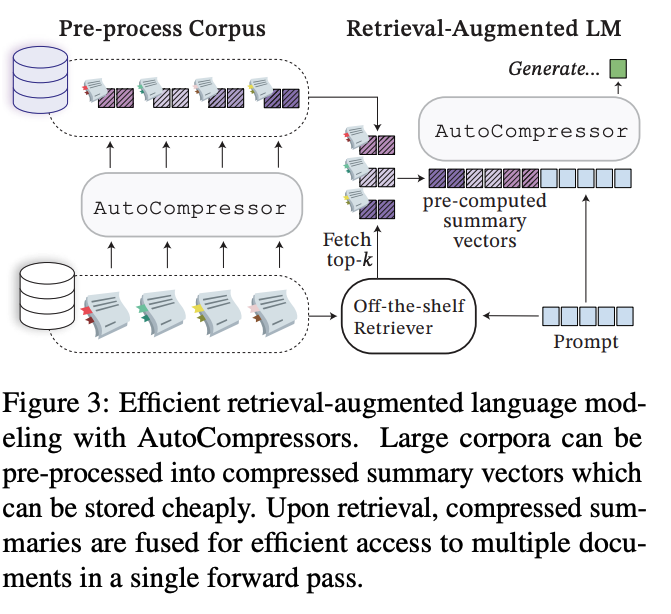
| Retrieval 활용 | 대규모 corpus의 passage를 미리 summary vectors로 압축해 저장한 뒤 retrieval-augmented LM과 passage re-ranking에 사용함. Fused summary vectors는 효율성과 성능의 trade-off에서 좋은 결과를 보임. |
| 주요 공헌 | ① 사전학습 LM을 context compressor로 변환하는 방법 제안 ② summary accumulation으로 장거리 정보 유지 개선 ③ LM loss만으로 unsupervised compression 학습 ④ ICL, RAG, re-ranking에서 summary vectors의 활용 가능성 입증 |
| 핵심 한계 | Summary vectors가 full attention이 접근하는 원문 정보를 완전히 보존하지 못함. 모델 규모도 OPT-2.7B, Llama-2-7B 수준에 제한됨. summary vector 수를 늘려도 항상 성능이 좋아지지 않음. |
| 연구적 의미 | 이 논문은 long-context 문제를 단순히 attention 구조 확장으로 해결하지 않고, 문맥을 continuous memory로 압축해 재사용하는 방향을 제시함. Long-CoT compression, memory-augmented LM, efficient RAG, privacy-preserving representation 연구와 연결 가능성이 큼. |
| 한 줄 평가 | AutoCompressor는 긴 문맥을 latent soft prompt로 압축하여 context window 확장과 inference 비용 절감을 동시에 노린 실용적 long-context adaptation 방법이다. |
728x90
'인공지능 > 논문 리뷰 or 진행' 카테고리의 다른 글
| LCIRC: A Recurrent Compression Approach for Efficient Long-form Context and Query Dependent Modeling in LLMs (0) | 2026.05.07 |
|---|---|
| R1-Compress: Long Chain-of-Thought Compressionvia Chunk Compression and Search (0) | 2026.04.26 |
| OSCAR: Online Soft Compression And Reranking (1) | 2026.04.26 |
| Sequential Efficient LLM 논문 -3 (0) | 2026.03.03 |
| Sequential Efficient LLM 논문 -2 (0) | 2026.03.03 |